Examples & Applications
Step-by-step worked examples demonstrating the binomial theorem in action. From basic expansions to coefficient extraction and probability applications.
📝 Example 1: Expand (2x + 3y)³
Expanding a binomial with numerical coefficients requires applying the binomial theorem and then simplifying.
Step-by-Step Solution
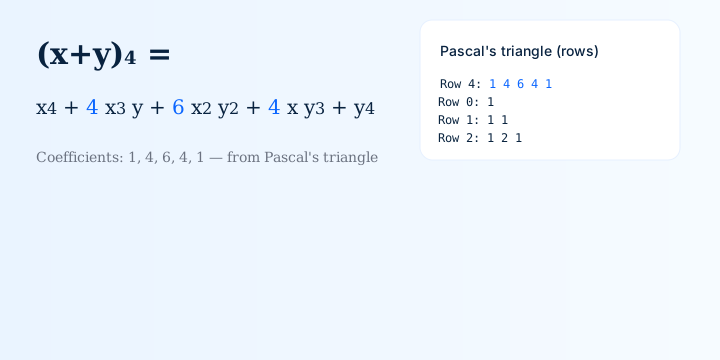
Step 1: Identify coefficients from Pascal's triangle (row 3): 1, 3, 3, 1
Step 2: Apply to (2x + 3y)³:
(2x + 3y)³ = 1·(2x)³ + 3·(2x)²(3y) + 3·(2x)(3y)² + 1·(3y)³
Step 3: Compute each term:
= 1·8x³ + 3·4x²·3y + 3·2x·9y² + 1·27y³
Step 4: Simplify:
= 8x³ + 36x²y + 54xy² + 27y³
✅ Verification: Set x=1, y=1 → (2+3)³ = 125; 8+36+54+27 = 125 ✓
🎯 Example 2: Coefficient Extraction
Finding the coefficient of a specific power in a binomial expansion is a common problem.
Problem
Find the coefficient of x⁷ in (2x − 3)¹⁰
Solution
Step 1: Rewrite as (2x + (−3))¹⁰
Step 2: General term formula:
Tk+1 = C(10,k) · (2x)¹⁰⁻ᵏ · (−3)ᵏ
Step 3: Find k where exponent of x is 7:
10 − k = 7 → k = 3
Step 4: Compute the coefficient:
Coefficient = C(10,3) · 2⁷ · (−3)³
= 120 · 128 · (−27)
= −414,720
💡 Key Technique
For (ax + b)ⁿ, the term containing xᵏ is Tn−k+1 = C(n, n−k) aᵏ bⁿ⁻ᵏ. Remember to include both the binomial coefficient AND the powers of a and b!
🎲 Example 3: Binomial Probability
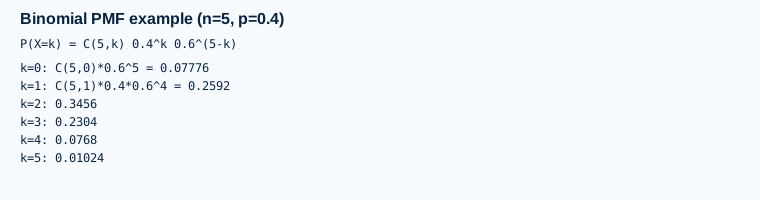
The binomial theorem is the foundation of the binomial distribution in probability theory.
Problem
A fair coin is flipped 5 times. What is the probability of getting exactly 3 heads?
Solution
Parameters: n = 5 trials, p = 0.5 (heads), k = 3 successes
Binomial PMF formula:
P(X = k) = C(n,k) × pᵏ × (1−p)ⁿ⁻ᵏ
Substitute values:
P(X = 3) = C(5,3) × (0.5)³ × (0.5)²
= 10 × 0.125 × 0.25
= 10 × 0.03125
= 0.3125 (or 31.25%)
∞ Example 4: Infinite Series (Generalized Binomial Theorem)
When the exponent is not a positive integer, we get an infinite series that converges for |x| < 1.
Problem
Find the first 4 terms of the expansion of (1 + x)¹ᐟ² (square root)
Solution
Generalized binomial coefficient:
C(½, k) = (½)(½−1)(½−2)...(½−k+1) / k!
Computing first 4 terms:
C(½, 0) = 1 → term: 1
C(½, 1) = ½ → term: (½)x
C(½, 2) = (½)(−½)/2 = −1/8 → term: −(1/8)x²
C(½, 3) = (½)(−½)(−3/2)/6 = 1/16 → term: +(1/16)x³
Result:
√(1+x) = 1 + ½x − ⅛x² + ₁₁₆x³ + ...
⚠️ Convergence Note
This infinite series converges only when |x| < 1. For |x| ≥ 1, the series diverges and does not equal the actual value.
✏️ Practice Problems
Problem 1: Expand (x + 2y)⁵
Solution:
Coefficients: 1, 5, 10, 10, 5, 1
= x⁵ + 5x⁴(2y) + 10x³(2y)² + 10x²(2y)³ + 5x(2y)⁴ + (2y)⁵
= x⁵ + 10x⁴y + 40x³y² + 80x²y³ + 80xy⁴ + 32y⁵
Problem 2: Sum of Coefficients Identity
Show that Σ C(n,k) = 2ⁿ
Proof: Set x = 1, y = 1 in the binomial theorem:
(1 + 1)ⁿ = Σ C(n,k) × 1ⁿ⁻ᵏ × 1ᵏ = Σ C(n,k)
2ⁿ = Σ C(n,k) ✓
Problem 3: Alternating Sum
Show that Σ (−1)ᵏ C(n,k) = 0 for n > 0
Proof: Set x = 1, y = −1:
(1 + (−1))ⁿ = Σ C(n,k) × 1ⁿ⁻ᵏ × (−1)ᵏ
0ⁿ = Σ (−1)ᵏ C(n,k)
0 = Σ (−1)ᵏ C(n,k) for n > 0 ✓
📋 Quick Reference: Common Expansions
(x + y)²
x² + 2xy + y²
(x + y)³
x³ + 3x²y + 3xy² + y³
(x + y)⁴
x⁴ + 4x³y + 6x²y² + 4xy³ + y⁴
(x + y)⁵
x⁵ + 5x⁴y + 10x³y² + 10x²y³ + 5xy⁴ + y⁵
🔗 Related Topics
📐 Definition
Learn the formal definition and properties of binomial coefficients.
🔬 Proofs
Understand why the binomial theorem is true through multiple proofs.
🖩 Calculator
Compute expansions instantly with our interactive calculator.
📚 Resources
References, textbooks, and LaTeX snippets for further study.