Proofs of the Binomial Theorem
The binomial theorem can be proved in multiple elegant ways. This page presents four distinct approaches: combinatorial counting, mathematical induction, algebraic manipulation, and probability theory. Each proof offers unique insights into why this fundamental theorem is true.
🔢 Proof 1: Combinatorial (Counting) Proof
The most intuitive proof uses the fundamental counting principle. Consider expanding (x + y)ⁿ as the product of n identical factors:
(x + y)ⁿ = (x + y)(x + y)(x + y)⋯(x + y)
n factors
Key Insight
When multiplying this product, each term in the expansion is formed by choosing either x or y from each factor. To obtain a term of the form xn−kyk, we must:
- Choose y from exactly k of the n factors
- Choose x from the remaining n−k factors

Counting the Ways
The number of distinct ways to choose which k factors contribute y is given by the binomial coefficient:
Number of ways = C(n, k) = n! / (k! × (n−k)!)
Worked Example: Coefficient of x²y² in (x + y)⁴
Step 1: We need exactly 2 y's and 2 x's
Step 2: Choose which 2 of the 4 factors contribute y:
Positions: {1,2}, {1,3}, {1,4}, {2,3}, {2,4}, {3,4}
Step 3: Count: C(4, 2) = 6 ways
✅ Conclusion: Coefficient of x²y² is 6
💡 Why This Proof Is Elegant
- No algebraic manipulation required—just counting!
- Provides intuition for why the coefficients have their values
- Generalizes naturally to multinomial expansions
🔄 Proof 2: Mathematical Induction
Proof by induction establishes the theorem for all nonnegative integers n using two key steps.
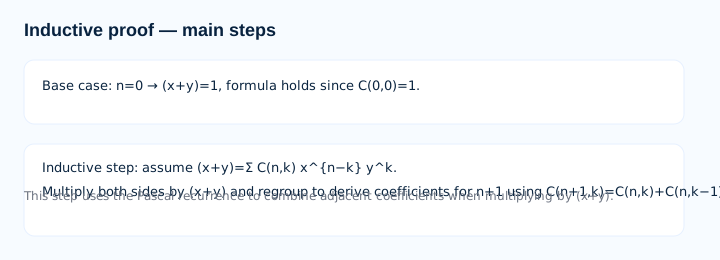
Step 1: Base Case (n = 0)
(x + y)⁰ = 1
Σk=0⁰ C(0,k) x⁰⁻ᵏ yᵏ = C(0,0) x⁰ y⁰ = 1
✅ Base case holds.
Step 2: Inductive Hypothesis
Assume for some n:
(x + y)ⁿ = Σk=0ⁿ C(n,k) xⁿ⁻ᵏ yᵏ
Step 3: Inductive Step
Prove for n + 1:
(x + y)ⁿ⁺¹ = (x + y)(x + y)ⁿ
= (x + y) × Σk=0ⁿ C(n,k) xⁿ⁻ᵏ yᵏ
= xΣ C(n,k)xⁿ⁻ᵏyᵏ + yΣ C(n,k)xⁿ⁻ᵏyᵏ
= Σ C(n,k)xⁿ⁻ᵏ⁺¹yᵏ + Σ C(n,k)xⁿ⁻ᵏyᵏ⁺¹
Step 4: Pascal's Identity
Using Pascal's Identity:
C(n,k) + C(n,k−1) = C(n+1,k)
We obtain:
(x + y)ⁿ⁺¹ = Σk=0ⁿ⁺¹ C(n+1,k) xⁿ⁺¹⁻ᵏ yᵏ
✅ Conclusion
By mathematical induction, the binomial theorem holds for all nonnegative integers n.
📐 Proof 3: Algebraic (Generating Functions)
This proof uses generating functions and formal power series.
The Generating Function Approach
(1 + x)ⁿ = (1 + x)(1 + x)⋯(1 + x)
When expanded, each term comes from choosing either 1 or x from each factor. The coefficient of xᵏ is exactly C(n,k).
Derivation
(1 + x)ⁿ = Σk=0ⁿ [n! / (k!(n−k)!)] × 1ⁿ⁻ᵏ × xᵏ
= Σk=0ⁿ C(n,k) xᵏ
Substituting x → y/x and multiplying by xⁿ:
(x + y)ⁿ = Σk=0ⁿ C(n,k) xⁿ⁻ᵏ yᵏ
Combinatorial Applications
- Subsets: C(n,k) = number of k-element subsets
- Lattice Paths: C(n,k) = paths from (0,0) to (k,n−k)
- Binary Strings: C(n,k) = strings of length n with k ones
- Polygon Diagonals: C(n,2) − n = diagonals in n-gon
🎲 Proof 4: Probability-Based Proof
Using expectation and linearity of expectation from probability theory.
Setup
n independent Bernoulli trials, success probability p. Let Xᵢ be indicator for success:
Xᵢ = 1 with prob p, 0 with prob (1−p)
Total successes: S = X₁ + X₂ + ⋯ + Xₙ
Computing E[(1 + t)ˢ]
E[(1 + t)ˢ] = ∏i=1ⁿ E[(1 + t)ˣⁱ]
E[(1 + t)ˣⁱ] = (1−p) + p(1 + t) = 1 + pt
E[(1 + t)ˢ] = (1 + pt)ⁿ
Expanding the PMF
P(S = k) = C(n,k) pᵏ (1−p)ⁿ⁻ᵏ
E[(1 + t)ˢ] = Σ P(S=k)(1+t)ᵏ = Σ C(n,k)[p(1+t)]ᵏ(1−p)ⁿ⁻ᵏ
= (1−p + p + pt)ⁿ = (1 + pt)ⁿ
💡 Key Insight
The expansion of (1 + pt)ⁿ encodes all binomial probabilities! This reveals the deep connection between the binomial theorem and the binomial distribution.
📊 Vandermonde's Identity
A powerful generalization of the binomial theorem:
Σk=0r C(m,k) × C(n,r−k) = C(m + n, r)
Combinatorial Proof
Problem: Count ways to choose r items from m + n items.
Solution 1: Direct: C(m + n, r)
Solution 2: Choose k from first m and r−k from last n:
Σk=0r C(m,k) × C(n,r−k)
Algebraic Proof
From (1 + x)ᵐ × (1 + x)ⁿ = (1 + x)ᵐ⁺ⁿ, the coefficient of xʳ is:
Σk=0r C(m,k) × C(n,r−k) = C(m + n, r)
Special Cases
- Σ C(r,k)² = C(2r, r) when m = n = r
- Σ C(n,k)² = C(2n, n) when r = m = n
📜 History of the Proofs
~300 BCE — Euclid
Proves (x+y)² = x² + 2xy + y² in Elements, establishing early combinatorial reasoning.
~1000 CE — Al-Karaji (Persia)
First known combinatorial proof for positive integer exponents.
1653 — Blaise Pascal
Publishes "Traité du triangle arithmétique", establishing Pascal's identity and inductive reasoning.
1665 — Isaac Newton
Extends the theorem to negative and fractional exponents.
1812 — Pierre-Simon Laplace
Connects binomial coefficients to probability theory.
🔗 Related Topics
❓ Proof Questions
Why are there multiple proofs of the binomial theorem?
Multiple proofs exist because the binomial theorem connects many areas of mathematics: combinatorics (counting), algebra (polynomial expansion), probability (binomial distribution), and induction (proof techniques). Each perspective provides different insights and applications.
What's the difference between regular and strong induction in this proof?
Regular mathematical induction suffices for the binomial theorem since we only need the case for n to prove n+1. Strong induction (assuming all cases up to n) is not necessary here but can be used as an alternative approach.
Can the combinatorial proof be made rigorous without induction?
Yes! The combinatorial proof is inherently rigorous through the fundamental counting principle. By explicitly counting the ways to form each term, we establish the coefficients directly without needing mathematical induction.
Why is Pascal's Identity crucial for the inductive proof?
Pascal's Identity (C(n+1,k) = C(n,k) + C(n,k−1)) is the key that allows us to combine the two sums in the inductive step. It emerges naturally from distributing (x+y) across the inductive hypothesis.
How does the probability proof relate to the other proofs?
The probability proof uses the moment generating function of a binomial random variable. It's essentially an algebraic proof viewed through a probabilistic lens, showing that (1 + pt)ⁿ encodes all binomial probabilities.
What generalizations of Vandermonde's identity exist?
Generalizations include the Chu-Vandermonde identity, q-Vandermonde formulas, and versions for multinomial coefficients. These appear in representation theory, special functions, and quantum computing.