Binomial Theorem
Master one of algebra's most fundamental formulas. Learn how to expand (x+y)ⁿ, understand binomial coefficients, and discover the deep connections between algebra, combinatorics, and probability theory.
Key Formula: (x+y)n = Σk=0n C(n,k) xn−k yk
Explore the Binomial Theorem
From basic definitions to advanced proofs, our comprehensive resource covers everything you need to understand and apply the binomial theorem effectively.
Definition & Formula
Formal mathematical statement, binomial coefficient notation C(n,k), Pascal's triangle, and key identities.
🔬Proofs
Combinatorial proof, mathematical induction, algebraic derivation, and probability-based proof approaches.
💡Examples & Applications
Step-by-step worked examples, coefficient extraction, binomial probability, and series expansions.
🖩Interactive Calculator
Compute binomial expansions instantly with customizable variables. Export LaTeX and download SVG.
📚Resources & Downloads
Downloadable SVG assets, LaTeX snippets, quick reference cards, and external learning materials.
ℹ️About & Attribution
Learn about our mission, licensing information, references, and how to contribute.
🔑 Key Concepts at a Glance
The Binomial Theorem
For any nonnegative integer n and variables x, y:
(x + y)n = Σk=0n C(n,k) xn−k yk
Provides a closed-form expansion of binomial powers.
Binomial Coefficients
The "n choose k" coefficient counts combinations:
C(n,k) = n! / (k!(n−k)!)
Also written as (n/k) or nCk.
Pascal's Triangle
Triangular array where each entry is the sum of two above:
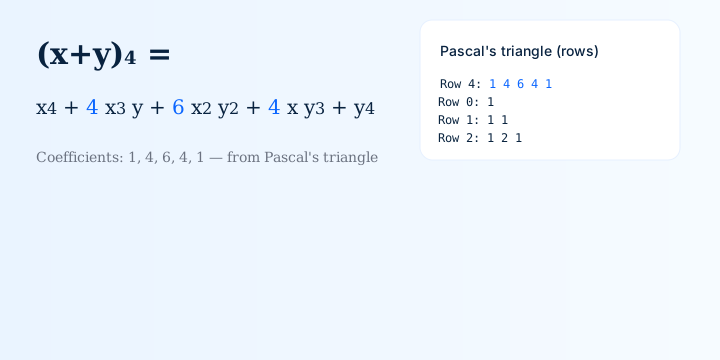
Row 4: 1 4 6 4 1
Row 5: 1 5 10 10 5 1
Each row gives coefficients for (x+y)n.
Binomial Distribution
Probability of k successes in n trials:
P(X=k) = C(n,k) pk (1−p)n−k
Foundation of statistics and probability theory.
📜 A Brief History
The binomial theorem has a rich history spanning centuries and civilizations:
~300 BCE
Euclid proves (x+y)² in Elements
~600 CE
Brahmagupta generalizes the theorem in India
10th-11th Century
Al-Karaji studies Pascal's triangle in Persia
14th Century
Yang Hui publishes the triangle in China
1653
Blaise Pascal publishes comprehensive treatise
1665
Newton extends to fractional exponents
🎯 Why the Binomial Theorem Matters
The binomial theorem is a cornerstone of mathematics with applications across many fields:
📐 Algebra
Expanding polynomials, simplifying expressions, and polynomial factorization.
🔢 Combinatorics
Counting combinations, subsets, and arrangements systematically.
🎲 Probability
Binomial distribution models success/failure experiments.
📊 Statistics
Hypothesis testing, confidence intervals, and statistical inference.
🔢 Number Theory
Modular arithmetic, divisibility, and combinatorial identities.
💻 Computer Science
Algorithm analysis, cryptography, and combinatorial optimization.
🔺 Pascal's Triangle
Pascal's triangle is a visual representation of binomial coefficients. Each row n contains the coefficients for (x + y)ⁿ. Click to view or download the SVG.

Quick Reference: Row 0 = 1 | Row 1 = 1, 1 | Row 2 = 1, 2, 1 | Row 3 = 1, 3, 3, 1 | Row 4 = 1, 4, 6, 4, 1 | Row 5 = 1, 5, 10, 10, 5, 1
🖩 Quick Calculator Demo
Try our interactive binomial expander right here:
📈 Essential Identities
These fundamental identities are derived from the binomial theorem and are essential tools in combinatorics:
Sum of Coefficients
Σ C(n,k) = 2ⁿ
Total number of subsets of an n-element set.
Alternating Sum
Σ (−1)ᵏ C(n,k) = 0 (n > 0)
Equal numbers of even and odd subsets.
Weighted Sum
Σ k·C(n,k) = n·2ⁿ⁻¹
Sum of all subset sizes.
Vandermonde's
Σ C(m,k)C(n,r−k) = C(m+n,r)
Combining independent choices.
Ready to Master the Binomial Theorem?
Start with the definition, explore the proofs, work through examples, and practice with our interactive calculator.